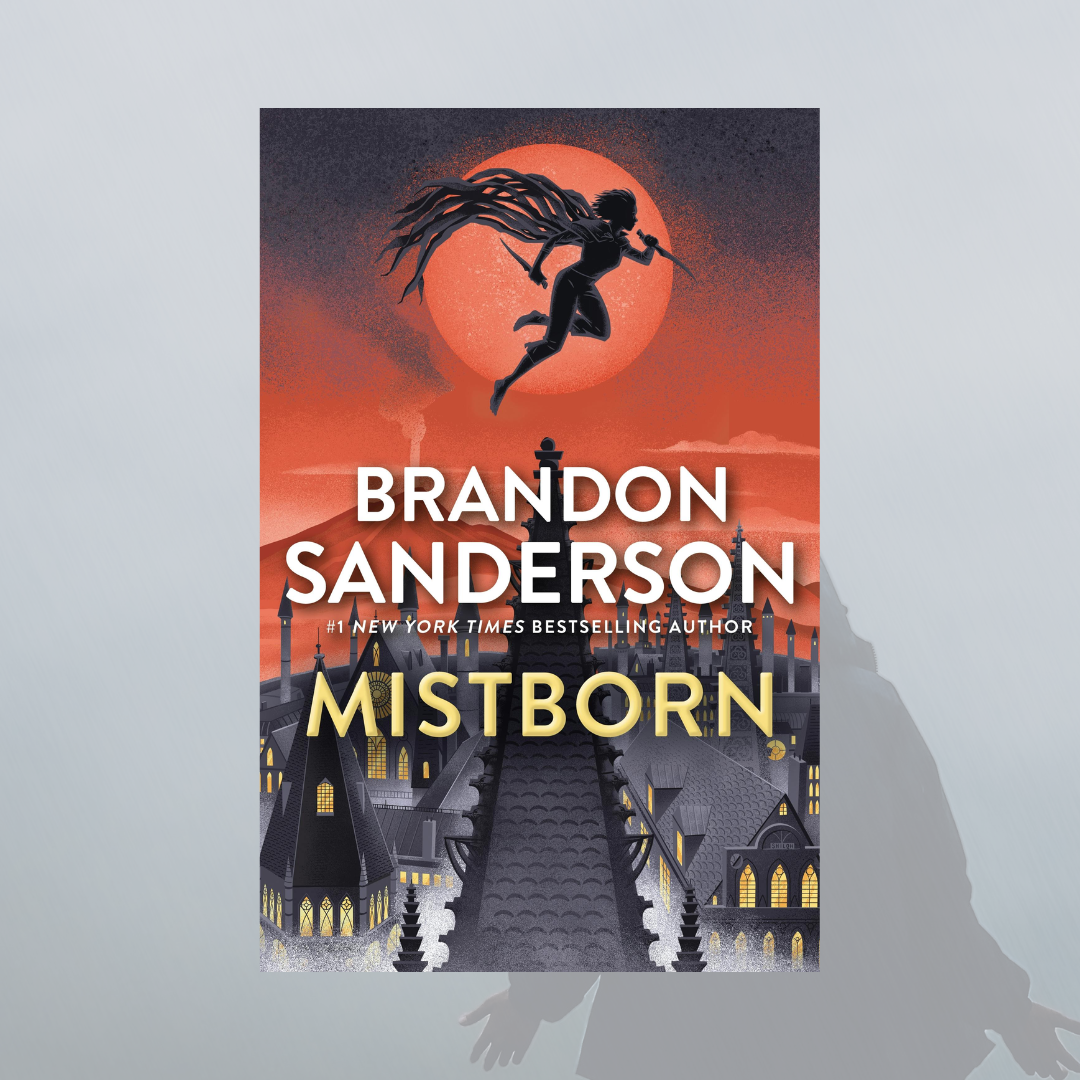
Spoiler-Free Review
For the uninitiated, the Mistborn series is currently broken into two eras. Era 1 consists of books 1-3 (and that’s what this review is for). Era 2 (Wax & Wayne) consists of books 4-7 and is a spin-off that follows a new set of characters many years after the events of Era 1.
According to Goodreads, Sanderson even has another era planned – a full trilogy titled Ghostbloods, book 1 of which is planned to release in 2028.
So if you, like me, thought it would ever be possible to catch up on the Sanderson backlog, join me in laughing at ourselves for the audacity.
Anyway, here’s my review for Mistborn Era 1.
What’s Mistborn about?
Vin, a teenaged girl of the lowest caste and reluctant member of a thieving crew, is singled out to join a new crew – except this one plans to assassinate the God King and eradicate the slavery and submission forced upon their people.
Book 1: The Final Empire
I knew just from the prologue that I was going to like this one, and I was right. From the worldbuilding to the characters to the magic system, it was clear Sanderson put a lot of thought and planning into this one.
I loved following Vin, our main character. Sanderson did a great job making her growth believable and honoring her good qualities. I also really loved Kelsier, another of our POV characters – he’s the one running this operation, and from chapter to chapter I could never decide how much to trust him. And yet, he was always likeable, even when I questioned his actions.
There were a few stretches here and there that were slower, and where my reading momentum slowed. But overall it was a great read.
Book 2: The Well of Ascension
Compared to book 1, this sequel was much slower. That said, it set up a lot of further worldbuilding and political machinations that I felt I needed to continue in this series. The characters continued to stand out.
I just didn’t feel consistent tension or intrigue throughout, so I wasn’t necessarily compelled to return to the book between reads. It took me a while to finish for that reason.
Book 3: The Hero of Ages
This was a fitting conclusion that explored a lot of interesting themes. I really felt like every detail fit perfectly in place; nothing felt like it was made up on the fly or forgotten. It was actually pretty incredible how many small details actually ended up being really important in answering the biggest questions.
I will say that I found my energy flagging around the middle. Another critique is the amount of page time we spent with characters as they inner monologued about what happened in the first two books. After a while I was skimming these bits.
The ending was devastating and fitting. It felt bittersweet but open, tragic but still hopeful.
Final Thoughts
This is high fantasy for the worldbuilding nerds (in a good way). The logic is airtight and cohesive, the magic system is consistent, and the rules are obeyed. It fully immerses the reader in its world.
This kind of worldbuilding can be a double-edge sword, so for me, there was a level of detail I didn’t always need. That’s not to say the story would have worked better without it. I think Sanderson really showed off his fantasy chops with this trilogy. I’ve also read Tress of the Emerald Sea, Warbreaker, and Skyward, which don’t have the same level of extensive on-page worldbuilding, and I think this highlights Sanderson’s ability to moderate his writing style according to the story he’s telling. That’s a rare talent.
Consistent with my experience of Sanderson so far, the characters were a big strength for this trilogy. Everyone was unique, everyone had flaws and virtues, and everyone had growth arcs from beginning to end. Side characters were not relegated to archetypal roles, but treated as if they were the main characters in their own stories.
My only real struggle with this trilogy can be distilled down to “middles.” The middle book intrigued me less than the other two, and all three books found my attention waning at the halfway points. Like when you throw a ball in the air and it floats for just a second at the apex of its trajectory – similarly, it seemed we spent every middle section in that floating space just a bit too long before the ball remembered to come back down and the plot went on.
Should you read Mistborn?
If you mostly read young adult fantasy and are looking to read more adult high fantasy, this is a great transition. It’s technically billed as a young adult fantasy, and there were times throughout where a plot point definitely felt like hallmark YA fantasy (mostly with books 1-2). However, some of its themes and content were more mature. Plus, a couple of our POV characters are adult men. On top of that, this trilogy spans 5 years, so our 16-year-old main character is a 21-year-old woman by the end. All of this keeps it from truly feeling YA.
I also recommend it to anyone who really enjoys extensive worldbuilding. If you’re the one asking follow-up questions about the deep lore of a world or the random magical offshoot that gets just a passing mention in a typical fantasy novel, you’ll enjoy this trilogy.
If worldbuilding isn’t always your thing, but you really enjoy strong character profiles and scrappy groups of people working together for the greater good, you’ll also enjoy this trilogy. But probably you’ll like book 1 most. If political fantasy is more your jam, you’ll like books 2-3 most.
Whatever your reason for diving in, be prepared for the long haul. Each book is 600+ pages.
I would love to have you around! Subscribe below.
Check out some of my other recent blogs: